.png)
Non-invasive treatment of varicose veins: Veinsound will change the game!
Dernière mise à jour : 14 janv.
A new era in varicose vein treatment: non-invasive vein occlusion without contrast agent injection successfully demonstrated in a preclinical model
Varicose veins are not just a cosmetic inconvenience. They can also cause heaviness, pain, and in some cases, circulatory complications. Current treatments are often invasive or restrictive, but Veinsound is pushing medical research forward. Its innovation for the non-invasive treatment of varicose veins, based on focused ultrasound technology — mechanical HIFU through cavitation — is set to change the lives of patients and phlebologists alike. This breakthrough has just been validated in a preclinical study published in the journal Ultrasound in Medicine and Biology, marking peer-reviewed recognition. For the first time, it is now possible to close a pathological vein in vivo without surgery, without heat, and most importantly, without any contrast agent injection.
What is mechanical HIFU and why is cavitation a revolutionary approach?
HIFU, or High-Intensity Focused Ultrasound, is a non-invasive technology that uses focused ultrasound waves to treat deep tissue. Already used in certain cancer or fibroid treatments, HIFU traditionally works through thermal effects, generating a rapid and localized increase in temperature to destroy targeted tissue.
A new approach is now being applied to treat varicose veins: mechanical HIFU, which does not destroy tissue with heat, but through cavitation. This phenomenon creates microscopic bubbles in the tissue, whose implosion produces micro-shockwaves capable of eroding vein walls in a targeted manner. Until now, this method required the injection of microbubble contrast agents to initiate cavitation. The device of Veinsound company demonstrates, for the first time, that this effect can be achieved without any injectable agent. It paves the way for a fully non-invasive treatment of varicose veins.

Cavitation and bubble implosion under high-pressure
How does our device work?
The device consists of spherical piezoelectric elements arranged in a confocal configuration, allowing energy to be focused precisely at a target zone located between 5 and 20 mm beneath the skin. This setup optimizes the total active surface area stabilizes the focal point, and minimizes thermal effects.
It generates a negative pressure which is sufficient to induce cavitation without the need for microbubbles.
A central ultrasound imaging probe provides real-time visualization of the cavitation cloud, while a membrane filled with degassed water ensures optimal contact with the skin and allows fine adjustment of treatment depth.
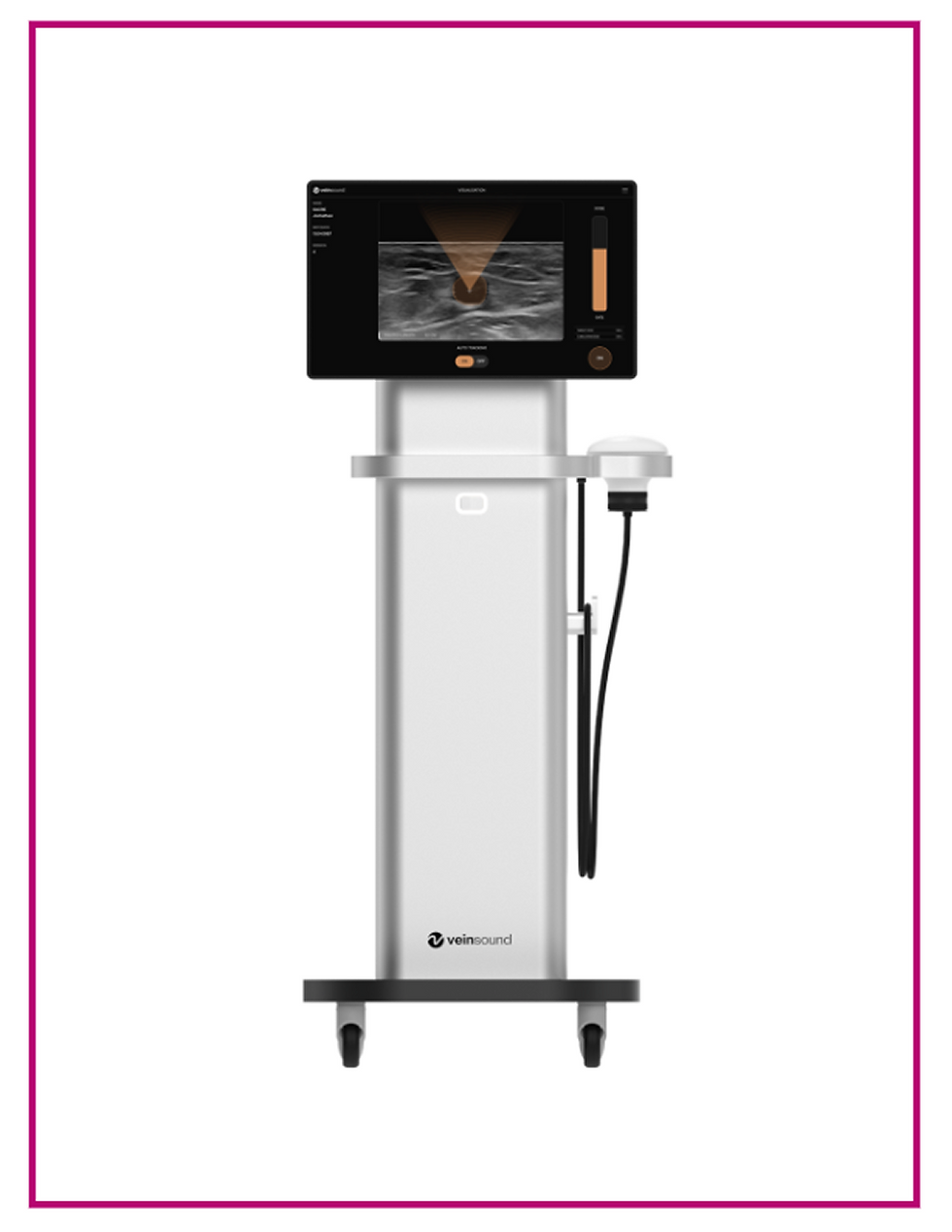

👉 Discover the device of Veinsound, our solution for non-invasive and non-thermal varicose vein treatment: www.veinsound.com
A preclinical breakthrough for the non-invasive treatment of varicose veins
Simulation and modeling
Researchers first assessed the acoustic performance of the device. The results showed that the negative pressure generated reached the required threshold to trigger cavitation in soft tissue (−23 MPa). The focal point was highly precise (0.8 × 0.9 × 2.9 mm), and the system demonstrated. These figures confirm that the energy is delivered with high intensity and accuracy, with minimal dispersion beyond the targeted area.
The effects of the treatment were then simulated using gel-based vein models (agar phantoms), representing veins of 2 mm and 5 mm in diameter.
In the 5 mm channels, centering the HIFU did not cause any erosion. However, when the focal point was positioned on the lateral or proximal walls, significant erosion was observed.
In the 2 mm channels, erosion was almost homogeneous except at the distal end of the vein, possibly due to the cavitation cloud blocking wave propagation.
On average, the erosion measured approximately 4 mm in diameter, confirming the mechanical HIFU’s ability to induce localized destruction of the vein walls.
In vivo preclinical feasibility proven in a sheep model
The team then tested the device on an anesthetized sheep, targeting a 3 mm collateral saphenous vein. HIFU was applied at three points along the vein. A cavitation cloud was observed in real time using ultrasound imaging.
The results showed:
Complete occlusion of the vein on the day of treatment, confirmed by ultrasound on days 3 and 7, with no return of blood flow.
Absence of skin damage.
Disappearance of the inner layer (intima) and marked sclerosis of the middle (media) and outer (adventitia) layers, as revealed by histological analysis—indicating permanent vein closure.
Key takeaways from this study:
|
The key benefits of High-Intensity Focused Ultrasound by cavitation for varicose vein treatment
Greater patient comfort
HIFU treatment requires neither tumescent anesthesia nor venous catheterization. It is completely non-invasive: no needles, no anesthesia, no scarring. In addition, targeting is extremely precise, since cavitation only affects the pathological area.
Enhanced safety
The procedure involves no intravenous injection, reducing associated risks. It is also performed without contrast agents, making it particularly suitable for allergic or at-risk patients.
Simplified procedure
The treatment can be performed directly in a medical office, without hospitalization. The intervention is guided in real time by ultrasound imaging, ensuring optimal control at every stage.
Improved cost-efficiency
This method requires fewer technical and human resources, making it a more economical solution for healthcare providers.
An eco-friendly approach
The absence of medical waste from the procedure makes it more environmentally responsible.
This study by Ganeau et al. lays the foundation for a new therapeutic strategy for varicose veins. Thanks to mechanical HIFU without microbubbles, treatment could become as simple as an imaging session: no needles, no pain, and nearly immediate recovery.This innovation in non-invasive varicose vein treatment paves the way for gentler, more targeted, and more patient-friendly medicine. Human clinical trials are now needed to confirm the safety, reproducibility, and long-term effectiveness of the approach. They will open the path toward market approval and global patient access to this non-invasive varicose vein therapy.
👉 Read more: Explore the evolving landscape of varicose vein treatments in our dedicated article: Evolving Solutions for Varicose Veins Treatment
Reference
Ganeau A, Charrel T, Pichot O, Lafon C. Preclinical Demonstration of In-Vivo Vein Occlusion by Mechanical HIFU Without Contrast Agent Injection: Paving the Way for the Non-Invasive Treatment of Varicose Veins. Ultrasound Med Biol. 2025 May 11. doi: 10.1016/j.ultrasmedbio.2025.04.004


